
Quality Management System (QMS): Meaning, Types, Processes & Software
A Quality Management System (QMS) is a structured system of policies, processes, and procedures that helps an organisation ensure consistent quality in its products or services. It enables businesses to meet customer requirements, comply with regulations, and improve quality through well-defined and documented processes.

Different Formats of Quality Management Systems (QMS)
A Quality Management System (QMS) can be implemented in different formats depending on an organisation’s size, industry, compliance needs, and level of digital maturity. While the goal of every QMS system is the same - consistent quality and regulatory compliance - the way it is managed has evolved over time.
Below are the most commonly used Quality Management System formats, ranging from manual to fully digital solutions.
Paper-Based Quality Management System
A paper-based QMS is the traditional approach to quality management. It relies on physical documents, files, and manual record-keeping to manage quality processes.
This format is simple to start with and requires minimal technology. Small organisations often adopt paper-based systems due to low upfront costs and familiarity. However, as operations grow, paper-based QMS becomes difficult to manage. Issues such as document loss, version control errors, slow audits, and limited visibility make compliance and scalability challenging.


Spreadsheet-Based Quality Management System
A spreadsheet-based QMS uses tools like Microsoft Excel, Google Sheets or ZOHO Sheets to manage quality records, track metrics, and document processes.
This format offers more structure than paper-based systems and is low-cost and flexible. However, spreadsheet-based QMS still depends heavily on manual effort. It lacks automation, is prone to human error, and makes audit readiness and version control difficult. As a long-term Quality Management System solution, spreadsheets do not scale well.
Electronic Quality Management System (eQMS)
An Electronic Quality Management System (eQMS) is a digital solution designed to manage quality processes in a centralised and automated way. eQMS replaces manual records with structured workflows, electronic approvals, and real-time tracking.
Modern eQMS software improves accuracy, audit readiness, and compliance while reducing manual effort. It also supports continuous improvement through better data visibility and reporting.
There are two main types of electronic QMS systems:
Cloud Based Quality Management System
A Cloud Based QMS (also called Web Based QMS Software) is hosted online and accessed through a web browser.
A cloud quality management system offers flexibility, scalability, and remote access. It reduces IT maintenance, supports automatic updates, and enables collaboration across teams and locations. Cloud-based QMS software systems are widely used today due to faster implementation and lower infrastructure costs.
On-Premise eQMS
An on-premise electronic QMS is installed on an organisation’s internal servers and managed by its IT team.
This format offers full control over data, strong security, and customisation options. It is often chosen by organisations with strict regulatory or data control requirements. However, on-premise eQMS involves higher upfront costs, ongoing maintenance, and limited remote access compared to cloud-based solutions.
Hybrid Quality Management System
A hybrid QMS combines elements of paper-based systems, spreadsheets, and electronic or cloud-based QMS software.
This approach allows organisations to transition gradually towards a fully digital Quality Management System Software while maintaining compliance. Hybrid systems can be useful during digital transformation, but they often introduce complexity, data silos, and integration challenges if not managed carefully.
| QMS Format | How It Works | Key Benefits | Limitations | Best Suited For |
|---|---|---|---|---|
|
Paper-Based QMS |
Uses physical documents, files, and manual records to manage quality processes |
Low initial cost, easy to start, no technical setup required |
Difficult version control, high risk of errors, slow audits, limited scalability |
Very small organisations with minimal compliance requirements |
|
Spreadsheet-Based QMS |
Manages quality data using tools like Excel, Google Sheets or Zoho Sheets |
Low cost, flexible, more structured than paper-based systems |
Manual effort, error-prone, poor audit readiness, limited automation |
Small teams transitioning from paper-based QMS |
|
On-Premise Electronic QMS (eQMS) |
Installed on internal servers and managed by in-house IT |
High data control, strong security, customisation |
High upfront cost, ongoing maintenance, limited remote access |
Organisations with strict data control or regulatory requirements |
|
Cloud Based QMS / Web Based QMS Software |
Hosted online and accessed through a web browser |
Scalable, remote access, automated updates, reduced IT maintenance |
Requires reliable internet, ongoing subscription costs |
Growing businesses and enterprises needing flexible quality management |
|
Hybrid Quality Management System |
Combines paper-based, spreadsheet, and electronic QMS processes |
Gradual digital transition, compliance continuity |
Integration complexity, data silos, harder to manage consistently |
Organisations in early or phased digital transformation |
Why is Quality Management System Important?
A Quality Management System (QMS) is important because it provides organisations with a structured and reliable way to control quality, manage compliance, and operate with confidence to enhance customer satisfaction.

A QMS system creates consistency in how work is performed, reviewed, and improved, ensuring that quality is not dependent on individuals but embedded into everyday operations.
A Quality Management System brings following benefits to an organisations:
- Deliver consistent and reliable products or services
- Meet customer expectations and regulatory requirements
- Reduce risks that affect product quality and safety
- Improve operational efficiency and reduce costly errors
- Support continuous improvement across the organisation
By maintaining proper records and documented processes, a QMS ensures that quality activities are carried out in a systematic and repeatable way.
Following Reasons State Why QMS is Important
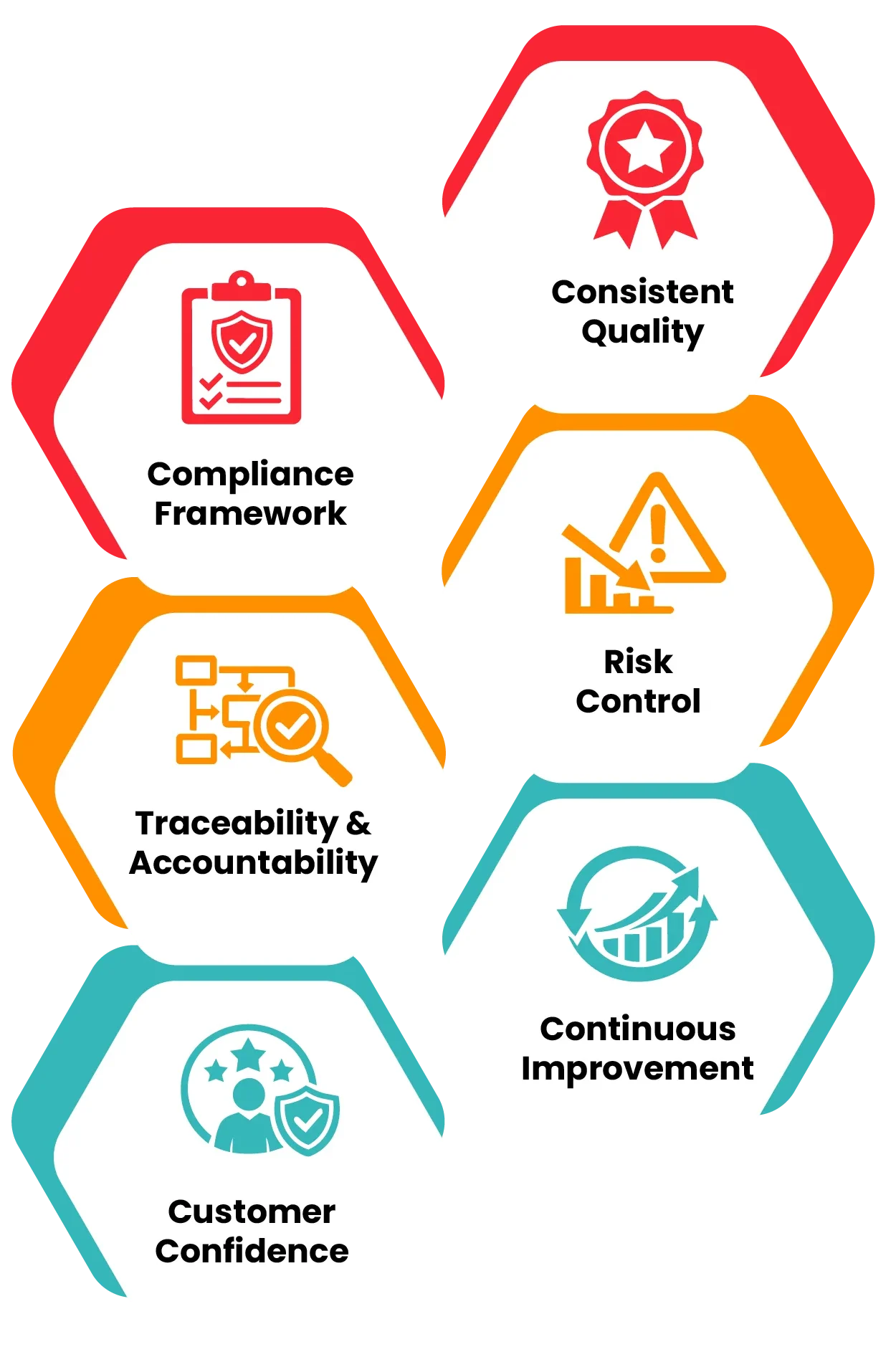
Provides a framework for regulatory and customer compliance
A Quality Management System helps organisations meet regulatory, legal, and customer requirements by defining clear processes, responsibilities, and controls. It ensures that policies, procedures, and records are documented, followed, and reviewed regularly.
Quality Management System Solution or eQMS software, helps organisations maintain audit readiness, demonstrate compliance, and reduce the risk of non-conformities during inspections or assessments.
Ensures consistent quality across the organisation
A QMS system standardises quality checks, product development and service rendering by enforcing SOPs. This standardisation is necessary to reduce variation and ensure that quality standards are applied uniformly across teams, departments, and location.
Enables traceability and accountability
A Quality Management System ensures traceability by recording what actions were taken, when they were taken, and by whom – solving investigation, audits and decision-making related complexity in an organisation.
With digital quality management software or a cloud based QMS, organisations gain centralised access to quality data, making it easier to track changes, review outcomes, and maintain accountability.
Helps identify and control quality risks
A QMS system identifies, assesses and controls risks that could affect product quality, safety, or compliance. Structured processes for issue management, root cause analysis, and corrective actions help organisations address problems before they escalate.
The best quality management solution provides timely alerts and facilitates faster resolution of quality issues, helping organisations to act proactively and mitigate the impact of possible consequences.
Supports customer confidence and organisational credibility
A Quality Management System provides assurance that quality is managed in a controlled and systematic way. By consistently meeting expectations and responding effectively to quality issues, organisations strengthen customer confidence and protect their reputation.
Creates a foundation for continuous improvement
By monitoring performance, reviewing quality data, and evaluating outcomes, a quality management system enables informed decisions and structured improvements.
When supported by QMS software systems or digital quality management system, organisations can maintain control as they grow and adapt to changing requirements.
Benefits of Implementing Quality Management System “QMS”
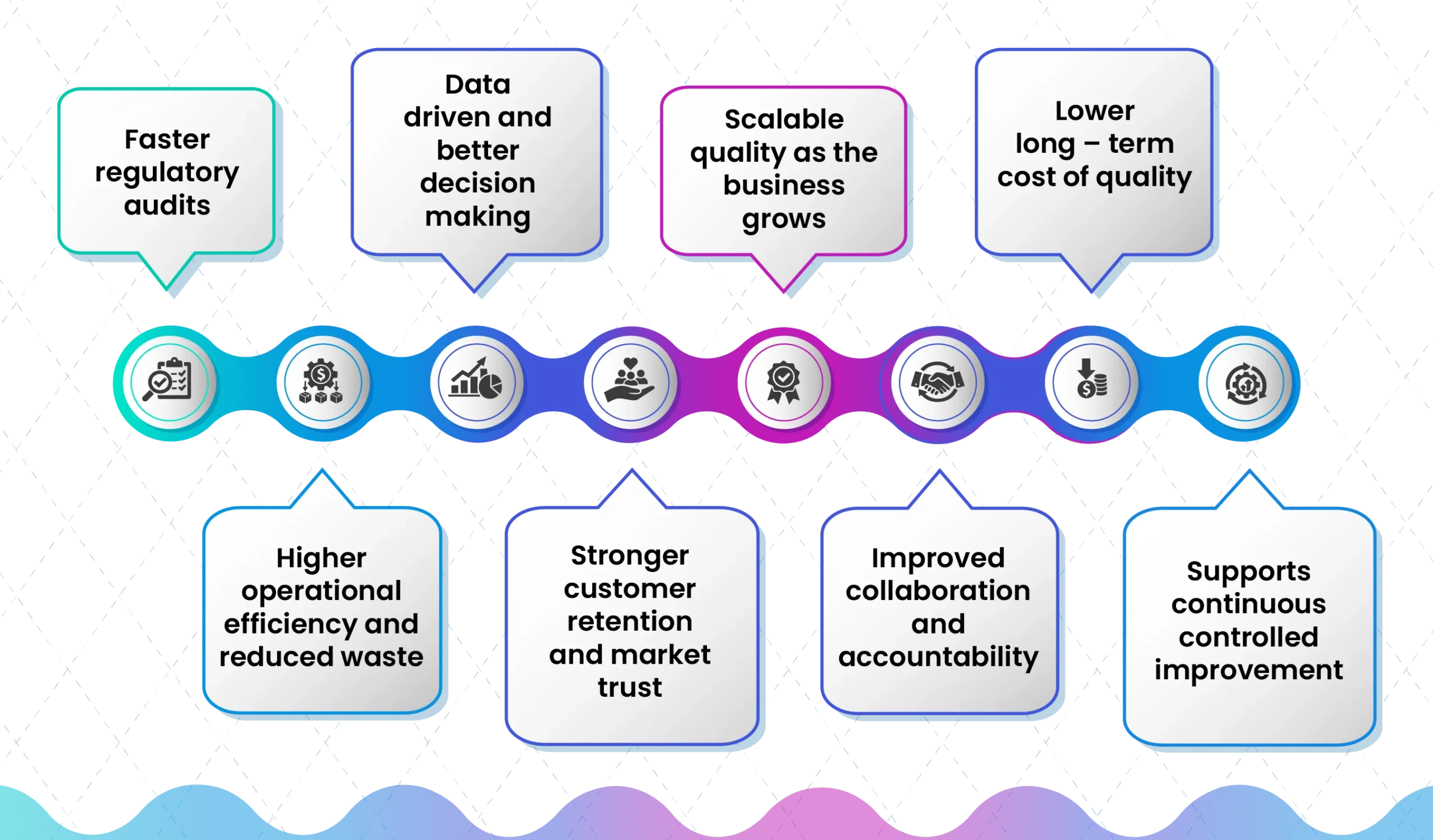
A Quality Management System brings following benefits to an organisations:
Faster and more confident regulatory audits
Quality Management Systems simplify audit preparation by keeping processes, documents, and records organised and accessible. With a digital quality management system or cloud based QMS solution, organisations can retrieve required information quickly, respond to audit findings with confidence, and reduce time spent on manual evidence collection, resulting smoother audits, and reduced operational disruption.

Data driven and better decision making
Quality Management System Solution provides centralised access to quality data, trends, and performance indicators. This visibility enables management teams to make informed decisions based on evidence rather than assumptions. With enterprise quality management software or cloud quality management software, organisations can identify patterns, prioritise improvements, and take corrective action faster.
Higher operational efficiency and reduced waste
A QMS system eliminates duplicated work, unclear responsibilities, and inconsistent processes. Standardised workflows improve efficiency across departments while reducing errors, rework, and unnecessary waste.
QMS helps organisations to automate routine quality activities, freeing teams to focus on value-adding work rather than administrative tasks.
Scalable quality
QMS software solutions provide the structure needed to scale operations without losing control. Whether implemented as a cloud based QMS software, web QMS, or enterprise quality management system software, a QMS ensures that quality processes remain consistent across locations, teams, and regions. This ensures that while teams, regions, and locations might vary, consumer experience remains constant.

Stronger customer retention and market trust
A Quality Management System supports reliable product and service delivery, helping organisations reduce complaints, respond effectively to issues, and meet customer expectations.
This consistency directly contributes to higher customer retention, improved brand reputation, and long-term business relationships.

Improved collaboration and accountability
A digital or electronic quality management system improves collaboration by providing a single source of truth for quality activities. Teams can access the same information, understand expectations clearly, and track responsibilities transparently.

Improved process standardisation across the organisation
A Quality Management System establishes uniform processes, definitions, and expectations across departments and teams. This reduces ambiguity, aligns operations, and ensures that tasks are performed consistently regardless of location or personnel. Standardisation strengthens quality control, simplifies training, improves process clarity, and creates a stable foundation for compliance, scalability, and long-term operational excellence.

Lower long – term cost of quality
By preventing errors, reducing rework, and addressing issues early, a Quality Management System lowers the overall cost of quality. Organisations avoid costly failures, recalls, and compliance issues while improving productivity.
Over time, the return on investment from implementing the best quality management software or best cloud based QMS becomes measurable and sustainable.
Supports continuous, controlled improvement
With structured review cycles, performance monitoring, and improvement tracking, organisations can evolve processes without introducing unnecessary risk. This ensures that changes are not only implemented effectively but also validated for long-term impact on quality outcomes. Quality Management System solutions provide the foundation needed to improve systematically while maintaining compliance, control, and alignment with organisational goals and regulatory expectations.
Different Types of Quality Management Systems
Quality Management Systems are used across industries to ensure consistent quality, regulatory compliance, and controlled operations. While the core principles of a QMS remain the same, how it is applied can vary based on the industry, products, services, and risk levels involved.
A Quality Management System can be adapted to support organisations of different sizes and sectors, from small businesses to large enterprises.
Most Common Quality Management Systems

Manufacturing QMS
Manufacturing organisations use a QMS system to control production processes, manage inspections, handle non-conformities, and ensure product consistency. Quality Management System helps manufacturers reduce defects, improve traceability, and maintain process control across batches and facilities.
A Manufacturing QMS also helps organisations align with standards such as ISO 9001, ISO 14001, and ISO 45001, supporting consistent quality, environmental management, and occupational health and safety compliance.

Life Sciences and Pharmaceuticals QMS
In regulated industries such as pharmaceuticals, biotechnology, and life sciences, a QMS supports product safety, data integrity, and regulatory compliance. Electronic Quality Management Systems (eQMS software) help manage documentation, deviations, CAPA, audits, and change control in a structured and traceable manner.
In regulated industries such as pharmaceuticals, biotechnology, and life sciences, a QMS supports product safety, data integrity, and regulatory compliance. Electronic Quality Management Systems (eQMS software) help manage documentation, deviations, CAPA, audits, and change control in a structured and traceable manner.
A Pharmaceutical QMS Software in life sciences supports compliance with regulations and frameworks such as FDA 21 CFR Part 11, GxP, EU GMP, and ICH guidelines, helping organisations remain audit-ready and compliant across global markets.

Medical Device QMS
Medical device companies rely on a QMS to manage quality throughout the product lifecycle - from design and development to manufacturing and post-market activities. A digital quality management system ensures traceability, risk management, and controlled documentation across all stages.
Medical Device QMS helps organisations meet requirements of ISO 13485, FDA 21 CFR Part 820 (Quality System Regulation), and EU MDR, supporting product safety and regulatory approval.

Food and Beverage QMS
Food and beverage organisations implement a QMS to manage food safety, hygiene controls, supplier quality, and compliance with safety requirements. Cloud based QMS software enables centralised monitoring, faster issue resolution, and consistent quality across facilities.
A Food and Beverage QMS helps organisations achieve and maintain compliance with FDA FSMA, HACCP, ISO 22000, FSSC 22000, and BRCGS, strengthening food safety and regulatory confidence.

Automotive QMS
Industries such as automotive require strong process control, risk management, and traceability. Enterprise Quality Management Software supports quality planning, inspection management, and corrective actions across complex supply chains.
An Automotive QMS Software supports compliance with IATF 16949, along with core automotive quality tools such as APQP, PPAP, FMEA, and SPC, ensuring alignment with OEM and supplier quality requirements.
There can be a nuanced QMS for each industry. Thus, for industries like Healthcare, Finance, Construction, Oil and Gas, Plastic, Electronics and Appliances, Rubber and Tyre, Consumer Goods, Chemical and so on, there can be an industry-oriented QMS, each catering to industrial needs and nuances.
For example, a QMS can support ISO 9001 and ISO 27001 in finance, ISO 45001 and ISO 9001 in construction, API Q1/Q2 and ISO 29001 in oil and gas, and governance or donor compliance frameworks for NGOs.
Common Quality Management System (QMS) Requirements and Standards
A Quality Management System is typically aligned with recognised international standards and regulatory frameworks. These standards define how organisations should document processes, manage risks, maintain traceability, and ensure consistent quality outcomes.
While the specific requirements depend on the industry and market, most Quality Management Systems are built around one or more of the following standards.

ISO 9001 – Quality Management Systems
ISO 9001 is the most widely adopted Quality Management System standard and applies across industries. It defines core QMS requirements such as process control, documentation, internal audits, corrective actions, and management review.
Many organisations use ISO 9001 as the foundation of their QMS system to demonstrate consistent quality and customer focus.
ISO 13485 – Medical Devices
ISO 13485 specifies QMS requirements for organisations involved in the design, manufacture, and distribution of medical devices. It emphasises risk management, traceability, design controls, and regulatory compliance throughout the product lifecycle.
FDA 21 CFR Part 820 – Medical Device Quality System Regulation
FDA 21 CFR Part 820 defines current Good Manufacturing Practice (cGMP) requirements for medical devices distributed in the United States. It focuses on quality system controls, documentation, validation, and post-market activities.
QMS software systems help organisations manage these requirements in a structured and audit-ready manner.
ICH Q10 – Pharmaceutical Quality System
ICH Q10 provides a comprehensive quality framework for pharmaceutical and biopharmaceutical organisations. It supports quality throughout the product lifecycle, from development to commercial manufacturing.
A digital quality management system helps align pharmaceutical operations with ICH Q10 by supporting risk management, change control, and continuous improvement.
IATF 16949 – Automotive Industry
IATF 16949 defines quality management requirements for automotive manufacturers and suppliers. It emphasises defect prevention, process consistency, supplier quality, and continual improvement across the supply chain.
Enterprise Quality Management Software supports compliance by centralising audits, corrective actions, and supplier quality data.
AS9100 – Aerospace and Defence
AS9100 builds on ISO 9001 with additional requirements for risk management, product safety, and traceability in aerospace and defence manufacturing.
Organisations use QMS system software to manage complex documentation, inspections, and compliance requirements across high-risk environments.
ISO 22000 and HACCP- Food Safety
ISO 22000 and HACCP focus on identifying, controlling, and preventing food safety hazards across the food supply chain. These frameworks support food quality, traceability, and regulatory compliance.
Cloud based QMS software enables food and beverage organisations to manage safety controls, audits, and corrective actions centrally.
Approaches & Methodologies Used in QMS
A Quality Management System supports both quality approaches and structured methodologies that guide how organisations plan, control, and improve quality.
Approaches define the overall way quality is embedded across the organisation, while methodologies provide practical frameworks to implement and sustain those quality objectives.
Modern QMS systems and QMS software enable organisations to apply these approaches consistently, ensuring control, visibility, and continuous improvement at scale.
-
Plan-Do-Check-Act
-
Continuous Quality Improvement
-
Total Quality Management
-
Lean Quality Management
-
Six Sigma
-
Agile Quality Management
Plan-Do-Check-Act (PDCA)
The PDCA cycle is a foundational approach used within Quality Management Systems to support continuous improvement. It provides a structured method to plan changes, implement them, evaluate results, and standardise successful outcomes.
PDCA is embedded within most recognised QMS standards, including ISO 9001, and is commonly supported by digital quality management software through workflows, reviews, and performance tracking.
Continuous Quality Improvement (CQI)
Continuous Quality Improvement focuses on ongoing, incremental improvements to processes and outcomes. Rather than treating quality as a one-time activity, CQI ensures quality is reviewed and improved continuously.
QMS software solutions support CQI by capturing quality data, tracking trends, and enabling evidence-based improvements over time
Total Quality Management (TQM)
Total Quality Management (TQM) is an organisation-wide approach that promotes shared responsibility for quality. It emphasises leadership commitment, employee involvement, and customer focus.
A structured QMS system provides the framework needed to support TQM by defining responsibilities, standardising processes, and aligning quality objectives across teams.
Lean Quality Management
Lean focuses on eliminating waste, reducing inefficiencies, and improving process flow. Within a Quality Management System, Lean principles help organisations streamline quality activities while maintaining compliance and control.
Web-based QMS software and cloud-based quality management systems support Lean initiatives by simplifying documentation, reducing manual effort, and improving process visibility.
Six Sigma
Six Sigma is a data-driven methodology aimed at reducing defects and process variation. It uses structured analysis to identify root causes and implement corrective actions.
Digital Quality Management Systems support Six Sigma by providing accurate data, controlled corrective action workflows, and traceability across improvement initiatives.
Agile Quality Management
Agile Quality Management focuses on flexibility, collaboration, and rapid response to change. It is particularly relevant for organisations operating in dynamic environments or managing frequent updates to processes or products.
Cloud based QMS software enables Agile quality practices by supporting real-time access, faster approvals, and adaptable workflows without compromising compliance.
The PDCA cycle is a foundational approach used within Quality Management Systems to support continuous improvement. It provides a structured method to plan changes, implement them, evaluate results, and standardise successful outcomes.
PDCA is embedded within most recognised QMS standards, including ISO 9001, and is commonly supported by digital quality management software through workflows, reviews, and performance tracking.
Continuous Quality Improvement focuses on ongoing, incremental improvements to processes and outcomes. Rather than treating quality as a one-time activity, CQI ensures quality is reviewed and improved continuously.
QMS software solutions support CQI by capturing quality data, tracking trends, and enabling evidence-based improvements over time
Total Quality Management (TQM) is an organisation-wide approach that promotes shared responsibility for quality. It emphasises leadership commitment, employee involvement, and customer focus.
A structured QMS system provides the framework needed to support TQM by defining responsibilities, standardising processes, and aligning quality objectives across teams.
Lean focuses on eliminating waste, reducing inefficiencies, and improving process flow. Within a Quality Management System, Lean principles help organisations streamline quality activities while maintaining compliance and control.
Web-based QMS software and cloud-based quality management systems support Lean initiatives by simplifying documentation, reducing manual effort, and improving process visibility.
Six Sigma is a data-driven methodology aimed at reducing defects and process variation. It uses structured analysis to identify root causes and implement corrective actions.
Digital Quality Management Systems support Six Sigma by providing accurate data, controlled corrective action workflows, and traceability across improvement initiatives.
Agile Quality Management focuses on flexibility, collaboration, and rapid response to change. It is particularly relevant for organisations operating in dynamic environments or managing frequent updates to processes or products.
Cloud based QMS software enables Agile quality practices by supporting real-time access, faster approvals, and adaptable workflows without compromising compliance.
Applying Methodologies Through Quality Management System (QMS)
While these approaches provide direction, their effectiveness depends on consistent execution. Quality Management System Software, including eQMS systems and enterprise quality management software, enables organisations to apply multiple methodologies within a single, controlled framework.
By combining structured methodologies with digital execution, organisations achieve sustainable quality improvement without increasing complexity.
| Aspect | Quality Approach | Quality Methodology |
|---|---|---|
Definition |
A quality approach defines the overall way an organisation embeds quality into its culture, decision-making, and operations. |
A quality methodology is a structured framework or technique used to implement and improve quality processes. |
Purpose |
Sets the mindset and direction for managing quality across the organisation. |
Provides practical steps to plan, execute, measure, and improve quality activities. |
Scope |
Broad and strategic, influencing leadership, teams, and organisational behaviour. |
Focused and operational, targeting specific processes, workflows, or quality objectives. |
Focus Area |
How quality is viewed and prioritised across the business. |
How quality improvements are carried out in practice. |
Time Horizon |
Long-term and continuous. |
Can be applied short-term or long-term depending on objectives. |
Flexibility |
Adaptable based on organisational maturity and industry needs. |
Follows defined structures, cycles, or data-driven steps. |
Examples in QMS |
Continuous improvement culture, organisation-wide quality ownership, customer-focused quality management. |
PDCA, Continuous Quality Improvement (CQI), Total Quality Management (TQM), Lean, Six Sigma, Agile Quality Management. |
Role of QMS Software |
A QMS system supports approaches by standardising processes, aligning teams, and ensuring consistency. |
Digital QMS software enables methodologies through workflows, data tracking, corrective actions, and performance monitoring. |
Quality Management System (QMS) Documentation Structure
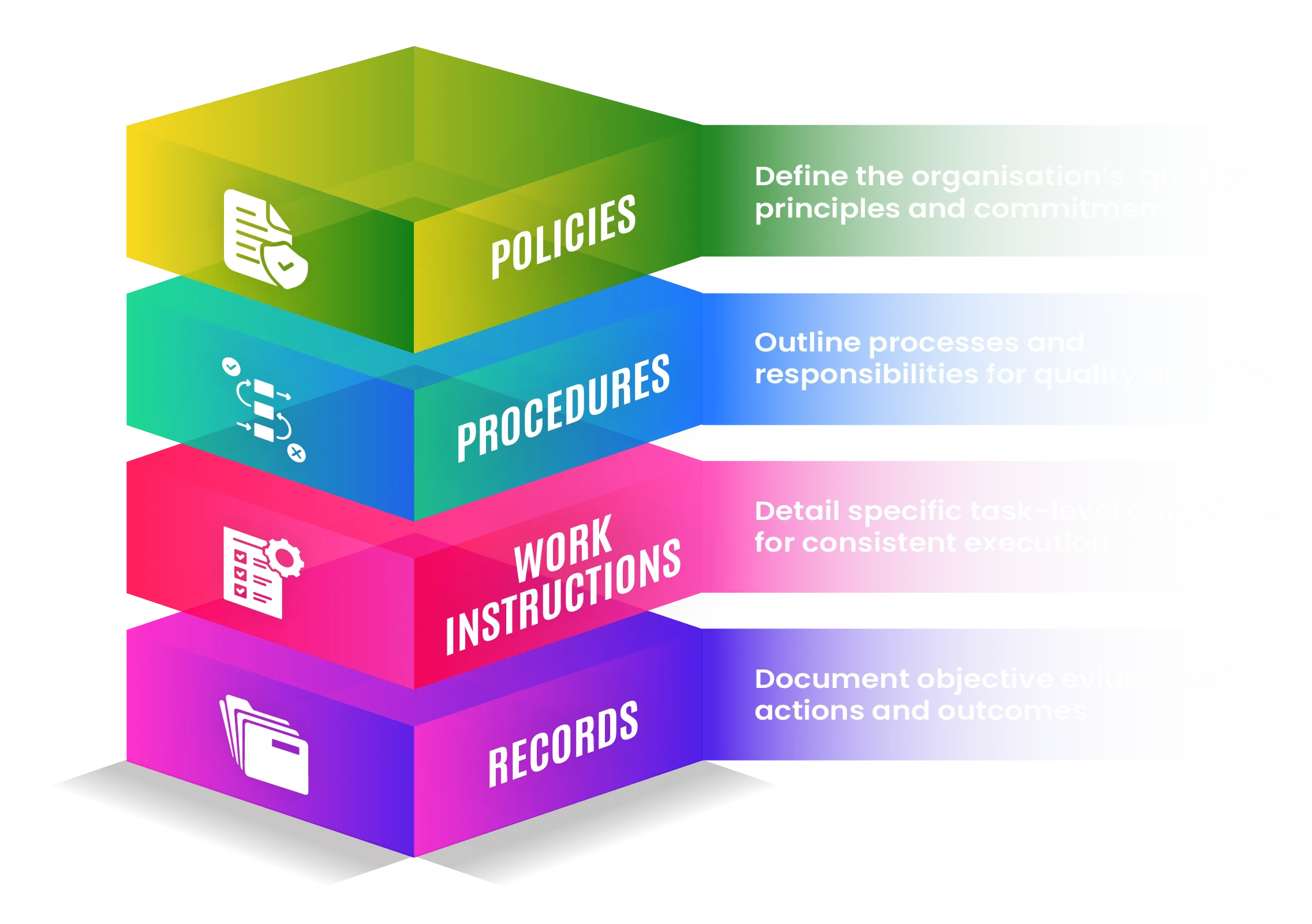
A Quality Management System relies on a clearly defined documentation structure to ensure consistency, control, and compliance across all quality activities. A well-organised QMS documentation framework helps organisations communicate expectations, standardise processes, and maintain objective evidence for audits and regulatory reviews.
In practice, QMS documentation is organised in a hierarchical structure, often visualised as a document pyramid. Each level serves a distinct purpose - from defining intent to capturing proof of execution - while remaining connected and traceable within the Quality Management System. A structured QMS system or QMS software enables organisations to manage this hierarchy centrally, ensuring documents remain current, accessible, and aligned with applicable standards.
Core Level of QMS Documentation

Policies
Policies define the organisation’s intent, principles, and commitment to quality. They establish the direction for the Quality Management System and provide a reference point for all supporting documents. Quality policies are typically approved by top management and aligned with regulatory and business objectives.
Procedures
Procedures describe how key quality processes are carried out across the organisation. They define responsibilities, sequence of activities, and controls required to ensure consistency and compliance. Procedures act as the operational backbone of the QMS, translating policy intent into controlled processes.
Work Instruction
Work instructions provide task-level guidance required to perform specific activities correctly and consistently. They support operational accuracy by detailing methods, tools, or steps where greater precision is needed. Work instructions are especially critical in regulated or high-risk environments.

Records
H3: Records Records capture evidence that activities have been performed as planned. They support traceability, accountability, and audit readiness by documenting outcomes such as inspections, training, audits, deviations, and approvals. Records are essential for demonstrating compliance and continuous improvement.
Why Documentation Structure Matters in QMS
A clearly defined documentation structure:
- Improves understanding and adoption of quality processes
- Reduces ambiguity and operational variation
- Strengthens audit readiness and regulatory compliance
- Enables traceability between policies, actions, and outcomes
Modern digital Quality Management Systems and web-based QMS software support this structure by linking documents, enforcing version control, and ensuring controlled access across teams and locations.
Core Quality Management System (QMS) Processes
Core Quality Management System processes are the essential, interconnected activities that enable organisations to control quality, maintain compliance, and drive continuous improvement. These processes define how quality is managed across documents, people, operations, suppliers, and risks - ensuring consistency, traceability, and accountability throughout the organisation.
A modern Quality Management System, supported by QMS software or cloud based QMS solutions, integrates these processes into a single, structured framework rather than treating them as isolated activities.
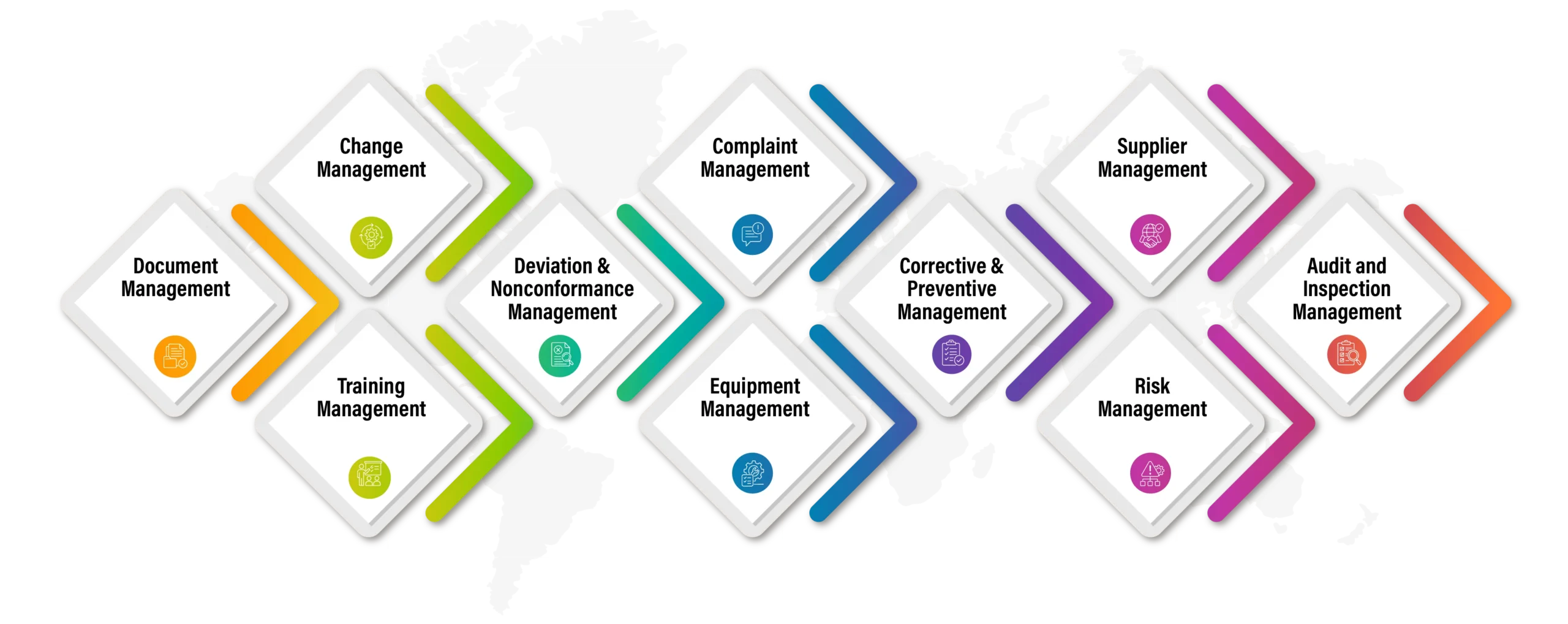
Below are the core processes commonly managed within an effective QMS:
Document Control ensures that all quality-related documents - including policies, procedures, work instructions, and records - are created, reviewed, approved, updated, and retired in a controlled manner.
A robust Document Management process prevents the use of outdated information, supports regulatory compliance, and ensures teams always work from the latest approved versions. Digital Quality Management Systems strengthen document control by enabling version control, approval workflows, access permissions, and audit trails.
Change Management provides a structured process for evaluating, approving, and implementing changes to processes, products, systems, or documentation.
Within a QMS system, Change Management ensures that proposed changes are assessed for risk and impact before implementation. This helps organisations adapt to regulatory updates, operational improvements, or customer requirements without compromising quality or compliance.
Training Management ensures that employees are competent, qualified, and aware of their quality responsibilities.
A QMS training process links roles, procedures, and training requirements, ensuring personnel receive appropriate training before performing quality-critical tasks. Quality Management System software simplifies training tracking, competency assessments, and training record management.
Deviation and Nonconformance Management governs how quality issues are identified, recorded, investigated, and resolved.
This process ensures that deviations from approved procedures, specifications, or requirements are handled systematically. By documenting issues and enforcing root cause analysis, organisations reduce the risk of recurrence and strengthen overall quality control.
Complaint Management defines how customer complaints are received, assessed, investigated, and resolved.
A structured complaint management process enables organisations to respond consistently to customer feedback, identify systemic issues, and demonstrate accountability to regulators and stakeholders. Integrated QMS software ensures complaints are traceable and linked to corrective actions where required.
CAPA Management is a central QMS process focused on eliminating the root causes of quality issues and preventing their recurrence.
CAPA processes connect deviations, nonconformances, complaints, audit findings, and risk assessments into a controlled improvement cycle. Digital QMS systems support CAPA through structured workflows, root cause tools, effectiveness checks, and complete traceability.
Equipment Management ensures that equipment used in manufacturing, testing, or quality control is suitable, calibrated, maintained, and properly retired.
This process helps maintain accuracy, reliability, and consistency in operations while reducing the risk of quality failures caused by equipment issues. Equipment management and Calibration management within a QMS supports compliance with regulatory and quality standards.
Supplier Management establishes a structured approach to selecting, evaluating, and monitoring suppliers.
By managing supplier qualification, performance, and corrective actions, a QMS helps organisations control supply chain risks and ensure consistent quality of incoming materials and services. Supplier management processes are particularly critical for regulated and quality-sensitive industries.
Risk Management within a Quality Management System focuses on identifying, assessing, controlling, and monitoring risks that could impact product quality, safety, or compliance.
A risk-based QMS approach enables organisations to prioritise actions, allocate resources effectively, and prevent issues before they occur. QMS software supports risk management by linking risks to controls, CAPAs, and change management activities.
Audit Management and Inspection Management governs the planning, execution, and follow-up of internal audits, supplier audits, and regulatory inspections.
This process ensures that quality processes are implemented as intended and remain compliant with internal policies and external standards. A centralised QMS simplifies audit scheduling, findings management, corrective actions, and inspection readiness.
Document Control ensures that all quality-related documents - including policies, procedures, work instructions, and records - are created, reviewed, approved, updated, and retired in a controlled manner.
A robust document management process prevents the use of outdated information, supports regulatory compliance, and ensures teams always work from the latest approved versions. Digital Quality Management Systems strengthen document control by enabling version control, approval workflows, access permissions, and audit trails.
Change Management provides a structured process for evaluating, approving, and implementing changes to processes, products, systems, or documentation.
Within a QMS system, change management ensures that proposed changes are assessed for risk and impact before implementation. This helps organisations adapt to regulatory updates, operational improvements, or customer requirements without compromising quality or compliance.
Training Management ensures that employees are competent, qualified, and aware of their quality responsibilities.
A QMS training process links roles, procedures, and training requirements, ensuring personnel receive appropriate training before performing quality-critical tasks. Quality Management System software simplifies training tracking, competency assessments, and training record management.
Deviation and Nonconformance Management governs how quality issues are identified, recorded, investigated, and resolved.
This process ensures that deviations from approved procedures, specifications, or requirements are handled systematically. By documenting issues and enforcing root cause analysis, organisations reduce the risk of recurrence and strengthen overall quality control.
Complaint Management defines how customer complaints are received, assessed, investigated, and resolved.
A structured complaint management process enables organisations to respond consistently to customer feedback, identify systemic issues, and demonstrate accountability to regulators and stakeholders. Integrated QMS software ensures complaints are traceable and linked to corrective actions where required.
CAPA Management is a central QMS process focused on eliminating the root causes of quality issues and preventing their recurrence.
CAPA processes connect deviations, nonconformances, complaints, audit findings, and risk assessments into a controlled improvement cycle. Digital QMS systems support CAPA through structured workflows, root cause tools, effectiveness checks, and complete traceability.
Equipment Management ensures that equipment used in manufacturing, testing, or quality control is suitable, calibrated, maintained, and properly retired.
This process helps maintain accuracy, reliability, and consistency in operations while reducing the risk of quality failures caused by equipment issues. Equipment management and Calibration management within a QMS supports compliance with regulatory and quality standards.
Supplier Management establishes a structured approach to selecting, evaluating, and monitoring suppliers.
By managing supplier qualification, performance, and corrective actions, a QMS helps organisations control supply chain risks and ensure consistent quality of incoming materials and services. Supplier management processes are particularly critical for regulated and quality-sensitive industries.
Risk Management within a Quality Management System focuses on identifying, assessing, controlling, and monitoring risks that could impact product quality, safety, or compliance.
A risk-based QMS approach enables organisations to prioritise actions, allocate resources effectively, and prevent issues before they occur. QMS software supports risk management by linking risks to controls, CAPAs, and change management activities.
Audit Management and Inspection Management governs the planning, execution, and follow-up of internal audits, supplier audits, and regulatory inspections.
This process ensures that quality processes are implemented as intended and remain compliant with internal policies and external standards. A centralised QMS simplifies audit scheduling, findings management, corrective actions, and inspection readiness.
How to Establish and Implement a Quality Management System (QMS)?
Establishing and implementing a Quality Management System involves creating a structured framework that defines how quality is planned, controlled, monitored, and improved across an organisation.
Rather than being a one-time activity, QMS implementation is a phased and ongoing effort that aligns people, processes, and responsibilities around consistent quality outcomes.
Below are the key stages typically involved in establishing and implementing an effective Quality Management System.

Define Quality Objectives and Scope
The first step is to clearly define quality objectives that align with organisational goals, customer expectations, and applicable regulatory requirements. At the same time, the scope of the QMS must be established to determine which processes, functions, locations, and activities are covered. A clearly defined scope ensures that quality controls are applied consistently and that responsibilities are well understood across the organisation.
Establish a Quality Policy and Leadership Commitment
A Quality Management System must be supported by a clear quality policy that outlines the organisation’s commitment to quality, compliance, and continuous improvement. Leadership involvement is critical at this stage, as management sets direction, allocates resources, and reinforces accountability. Visible leadership commitment helps embed quality into organisational culture rather than treating it as a standalone function.


Identify and Structure Key Processes
Once objectives and scope are defined, organisations identify the core and supporting processes that affect quality outcomes. These processes are structured and documented to clarify how work is performed and how activities interact. Standardising processes through defined procedures and responsibilities helps reduce variation, improve consistency, and support regulatory and customer requirements.
Establish Document and Record Controls
Controlled documentation is a foundational element of any QMS. Organisations must define how policies, procedures, work instructions, and records are created, reviewed, approved, updated, and retained. Clear document and record controls ensure that accurate information is available when needed and that evidence of compliance and performance can be demonstrated during audits or assessments. Once established, a quality management system solution helps them to manage effectively, removing chaos of document management.


Build Competence Through Training and Awareness
A QMS is only effective when people understand their roles within it. Training and awareness activities ensure that employees are competent to perform their tasks and aware of quality requirements relevant to their responsibilities. This stage focuses on building consistency, reducing errors, and reinforcing accountability across all levels of the organisation.
Apply Risk-based Thinking and Issue Management
Modern Quality Management Systems emphasise proactive risk identification and control. Organisations assess potential risks that could impact product quality, service delivery, or compliance, and define controls to manage them. At the same time, structured approaches are established to address deviations, nonconformities, and quality issues in a consistent and systematic manner.

Monitor Performance and Conduct Internal Reviews
To ensure the QMS is functioning as intended, organisations monitor performance using defined indicators, internal audits, and periodic reviews. These activities help verify that processes are being followed, objectives are being met, and controls remain effective. Regular reviews provide visibility into strengths, gaps, and improvement opportunities.
Drive Continuous Improvement
Implementation does not end once the QMS is in place. Continuous improvement ensures that the system evolves with changing business needs, customer expectations, and regulatory requirements. By reviewing performance data, audit results, and feedback, organisations refine processes and strengthen their Quality Management System over time.

What is Quality Management Software (QMS Software)?
Quality Management Software, often referred to as QMS software or eQMS software, is a digital solution that supports the implementation, operation, and ongoing management of a Quality Management System.
While a QMS defines what quality controls and processes an organisation must follow, QMS software provides the structured environment to manage those controls consistently, accurately, and at scale.
Quality Management Software centralises quality-related information, processes, and records, enabling organisations to maintain control over quality activities while meeting regulatory, customer, and internal requirements.
What Does a QMS Software Do?
QMS software supports the day-to-day execution of quality management by digitising and structuring core QMS processes. It enables organisations to manage quality in a controlled, traceable, and auditable manner, without relying on fragmented documents or manual tracking.
Typical capabilities of a Quality Management System software include:
-
Controlled management of policies, procedures, work instructions, and records
-
Structured handling of changes, deviations, and nonconformances
-
Corrective and preventive action (CAPA) tracking and follow-up
-
Training and competency management
-
Audit and inspection management
-
Supplier and quality risk management
By bringing these activities into a single system, QMS software helps ensure that quality processes are followed consistently, and that evidence of compliance is always available.
Six Benefits of Implementing Quality Management Software
Implementing Quality Management Software helps organisations move from manual, fragmented quality practices to a structured, reliable, and scalable quality framework. Rather than managing quality through disconnected tools and ad-hoc processes, QMS software provides a single system that supports consistency, compliance, and continuous improvement.
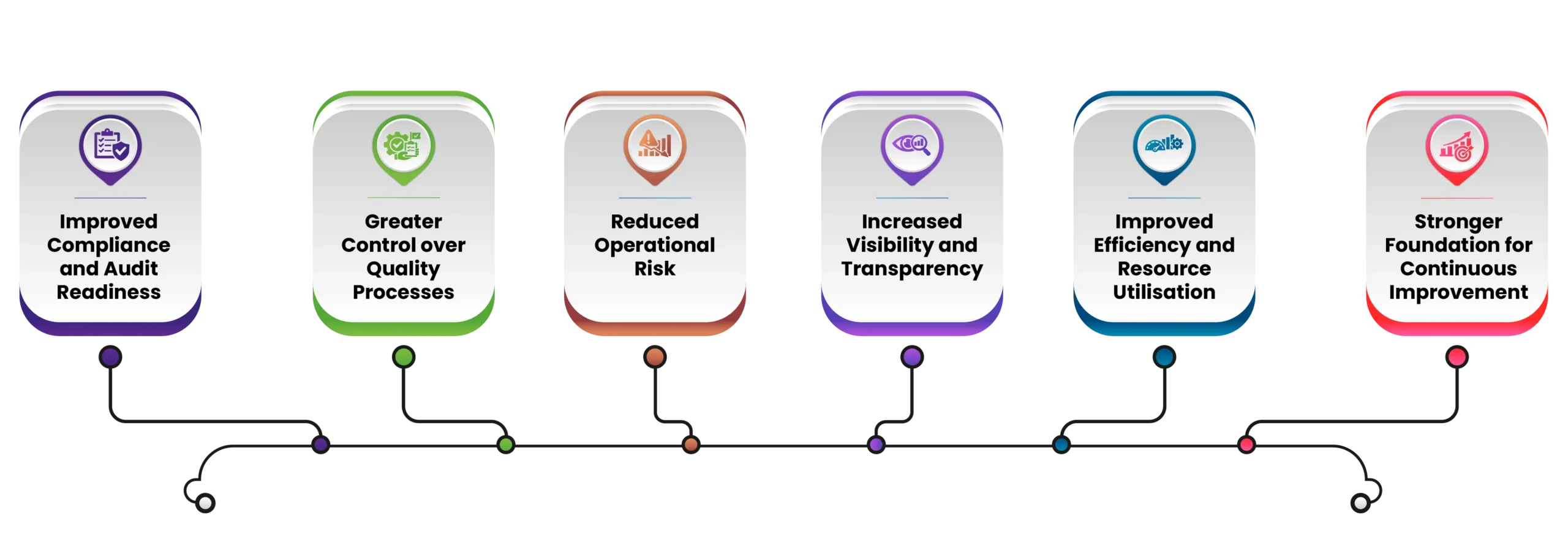
Following are major benefits of a quality management system software:
Quality Management Software helps organisations meet regulatory, industry, and customer requirements by ensuring quality processes are consistently followed and properly documented.
Standardised workflows, controlled documentation, and traceable records reduce the risk of non-compliance and make it easier to demonstrate adherence during internal and external audits. As a result, organisations remain audit-ready at all times, not just when an audit is scheduled.
As organisations grow, maintaining control over quality activities becomes increasingly challenging. QMS software introduces structure by defining how quality processes are created, reviewed, approved, and executed across teams and locations. This consistency reduces variation, prevents informal workarounds, and ensures quality requirements are applied uniformly throughout the organisation.
Manual quality management often relies on spreadsheets, emails, and shared drives, increasing the risk of errors, outdated information, and missing records. Quality Management Software reduces this risk by centralising quality data and enforcing controlled processes.
This structured approach helps organisations identify issues earlier, respond more effectively, and prevent small quality problems from escalating into larger operational or compliance risks.
QMS software provides organisations with a clear, real-time view of quality activities and performance. Leaders and quality teams can monitor key quality indicators, track trends, and understand where issues occur across processes, products, or departments.
This transparency supports informed decision-making and enables organisations to proactively improve quality rather than reacting to problems after they arise.
By reducing manual effort and eliminating duplicate or non-value-adding activities, Quality Management Software allows teams to spend less time managing paperwork and more time improving processes.
Structured workflows and centralised information help streamline quality operations, improve collaboration, and support smoother day-to-day execution of quality tasks.
Quality Management Software supports continuous improvement by capturing reliable quality data over time. Instead of relying on isolated incidents or assumptions, organisations can base improvement initiatives on accurate insights and documented evidence.
This data-driven approach helps build a culture where quality improvement is systematic, measurable, and aligned with business objectives.
Rather than replacing the Quality Management System itself, QMS software strengthens it — ensuring the system operates as intended across people, processes, and locations as organisational complexity increases.
Quality Management Software helps organisations meet regulatory, industry, and customer requirements by ensuring quality processes are consistently followed and properly documented.
Standardised workflows, controlled documentation, and traceable records reduce the risk of non-compliance and make it easier to demonstrate adherence during internal and external audits. As a result, organisations remain audit-ready at all times, not just when an audit is scheduled.
As organisations grow, maintaining control over quality activities becomes increasingly challenging. QMS software introduces structure by defining how quality processes are created, reviewed, approved, and executed across teams and locations. This consistency reduces variation, prevents informal workarounds, and ensures quality requirements are applied uniformly throughout the organisation.
Manual quality management often relies on spreadsheets, emails, and shared drives, increasing the risk of errors, outdated information, and missing records. Quality Management Software reduces this risk by centralising quality data and enforcing controlled processes.
This structured approach helps organisations identify issues earlier, respond more effectively, and prevent small quality problems from escalating into larger operational or compliance risks.
QMS software provides organisations with a clear, real-time view of quality activities and performance. Leaders and quality teams can monitor key quality indicators, track trends, and understand where issues occur across processes, products, or departments.
This transparency supports informed decision-making and enables organisations to proactively improve quality rather than reacting to problems after they arise.
By reducing manual effort and eliminating duplicate or non-value-adding activities, Quality Management Software allows teams to spend less time managing paperwork and more time improving processes.
Structured workflows and centralised information help streamline quality operations, improve collaboration, and support smoother day-to-day execution of quality tasks.
Quality Management Software supports continuous improvement by capturing reliable quality data over time. Instead of relying on isolated incidents or assumptions, organisations can base improvement initiatives on accurate insights and documented evidence.
This data-driven approach helps build a culture where quality improvement is systematic, measurable, and aligned with business objectives.
Rather than replacing the Quality Management System itself, QMS software strengthens it — ensuring the system operates as intended across people, processes, and locations as organisational complexity increases.
What is Electronic (eQMS) & Digital Quality Management Software?
Moving to an Electronic Quality Management System (eQMS) is not just a technology upgrade - it represents a shift from reactive quality control to digitally governed quality operations, and an eQMS Software facilitates organisation to achieve that.
While cloud-based and web-based QMS software defines how the system is accessed, a Digital Quality Management System defines how quality is executed, enforced, and proven across the organisation.

From Document Storage to Digital Quality Control
Traditional QMS environments often digitise documents but leave quality execution manual. eQMS software goes further by embedding quality rules directly into daily workflows. Approvals, reviews, escalations, and quality decisions are system-driven rather than people-dependent, reducing variability and compliance risk.

Built-in Traceability as a Quality Standard

Digital Enforcement of Quality Processes

Cloud-Based & Web-Based QMS Software
Modern Quality Management Systems are increasingly delivered as Web Based QMS Software and Cloud Based QMS Solutions. These platforms offer organisations the flexibility to access quality processes from anywhere, support distributed teams, and stay aligned with regulatory and operational requirements without the burden of traditional on-premise infrastructure.
Cloud and web delivery models ensure that quality data, documents, and workflows are accessible in real time, helping teams make faster, data-driven decisions and maintain control even as the organisation grows or operates across multiple sites.
Advantages of Cloud or Web Quality Management Software

Anywhere, Anytime Access
Cloud Quality Management Software enables authorised users to securely access the QMS through a web browser from any device and location. This supports remote work, cross-site collaboration, and real-time participation in quality activities, audits, and approvals.


Scalability Across Business Sizes
Whether you’re a small business taking first steps into digital quality management or a large enterprise managing complex, multi-site operations, cloud-based QMS scales with your needs. Adding users, expanding processes, or integrating new modules is simple and does not require additional infrastructure investment.

Automatic Updates and Maintenance
With cloud QMS platforms, software updates, security patches, and feature enhancements are delivered automatically. This ensures you always have access to the latest capabilities without manual upgrades or costly IT resources.


Lower Upfront Costs and Predictable Budgeting
Cloud Based QMS Software typically uses a subscription model that eliminates large capital expenses associated with servers and on-premise systems. Organisations benefit from predictable operational costs and reduced IT overhead.

Enhanced Compliance and Audit Support
Web Based QMS platforms provide centralised data storage, version control, and secure audit logs that support regulatory requirements and industry standards. Transparent audit trails and traceable records help organisations demonstrate compliance with ease.


Robust Security and Permissions Control
Cloud and web-enabled QMS solutions offer advanced security features including role-based access permissions, encryption, regular backups, and disaster recovery support. This protects sensitive quality data while ensuring the right users have appropriate access.

How to Choose the Best Quality Management Software?
Choosing the best QMS software is a strategic decision that directly impacts compliance, efficiency, and long-term quality performance. With many quality management solutions available, organisations must look beyond feature lists and evaluate how well a system supports real-world quality operations.
The right Quality Management Software should align with regulatory requirements, scale with business growth, and support consistent quality execution across teams and locations.
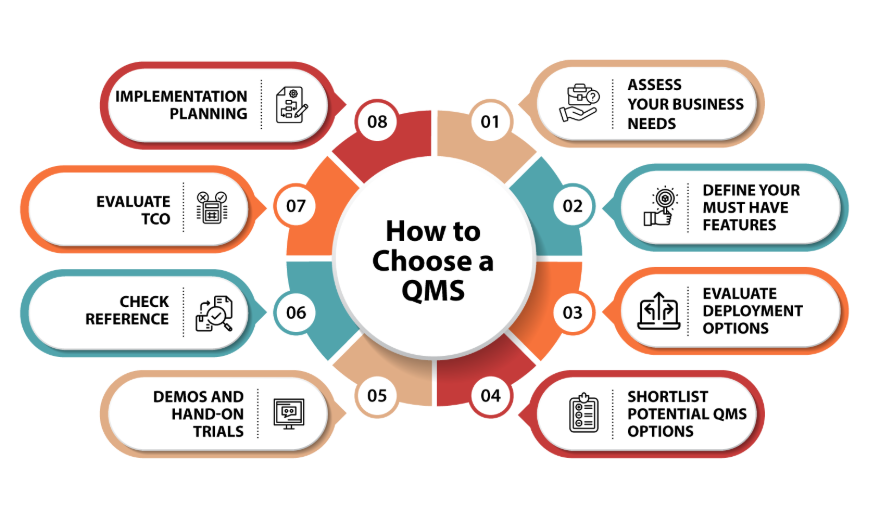
Key Factors to Evaluate When Selecting QMS Software?
Selecting a QMS is a tricky task. It involves time, money, and clarity. Before finalising any QMS software, evaluate the options on following factors:

Alignment with your quality processes
Start by assessing how closely the software supports your core quality management system processes. The best quality management software should handle document control, CAPA, audits, training, supplier quality, and risk management without forcing workarounds or manual tracking.
A top QMS software solution adapts to your processes - not the other way around.
Compliance and support
Regulatory alignment is non-negotiable. Evaluate whether the QMS software supports recognised standards such as ISO 9001, ISO 13485, IATF 16949, GMP, HACCP, or FDA requirements, depending on your industry.
Top quality management software provides built-in structure, traceability, and audit readiness to support ongoing compliance.


Cloud-based and web-based capabilities
Modern organisations increasingly prefer cloud-based QMS software and web-based QMS software for flexibility and scalability. A cloud quality management software solution allows secure browser-based access without the complexity of on-premise infrastructure.
This is especially important for multi-site operations, remote teams, and growing businesses.
Usability and adoption
Even the most powerful system fails if users struggle to adopt it. The best QMS software combines structured workflows with intuitive navigation, making it easy for teams to follow quality processes consistently.
Ease of use directly impacts data accuracy, process adherence, and audit outcomes.


Scalability and long term value
Top QMS software should support organisations at every stage - from small teams formalising quality systems to enterprise-level operations managing complex compliance needs.
Look for solutions that grow with your organisation, avoiding the need for costly system replacements later.
Quality Management System Software Evaluation Checklist
Use the checklist below when comparing top quality management software options:
-
Does the software support all core QMS processes?
-
Is it compliant with relevant quality and regulatory standards?
-
Is it available as cloud-based and web-based QMS software?
-
Does it provide role-based access and secure permissions?
-
Are audit trails and traceability built into every process?
-
Can it scale from small to enterprise-level use?
-
Is the interface intuitive for daily users?
-
Does the vendor provide implementation guidance and support?
A solution that consistently meets these criteria is more likely to qualify as the best QMS software for your organisation.
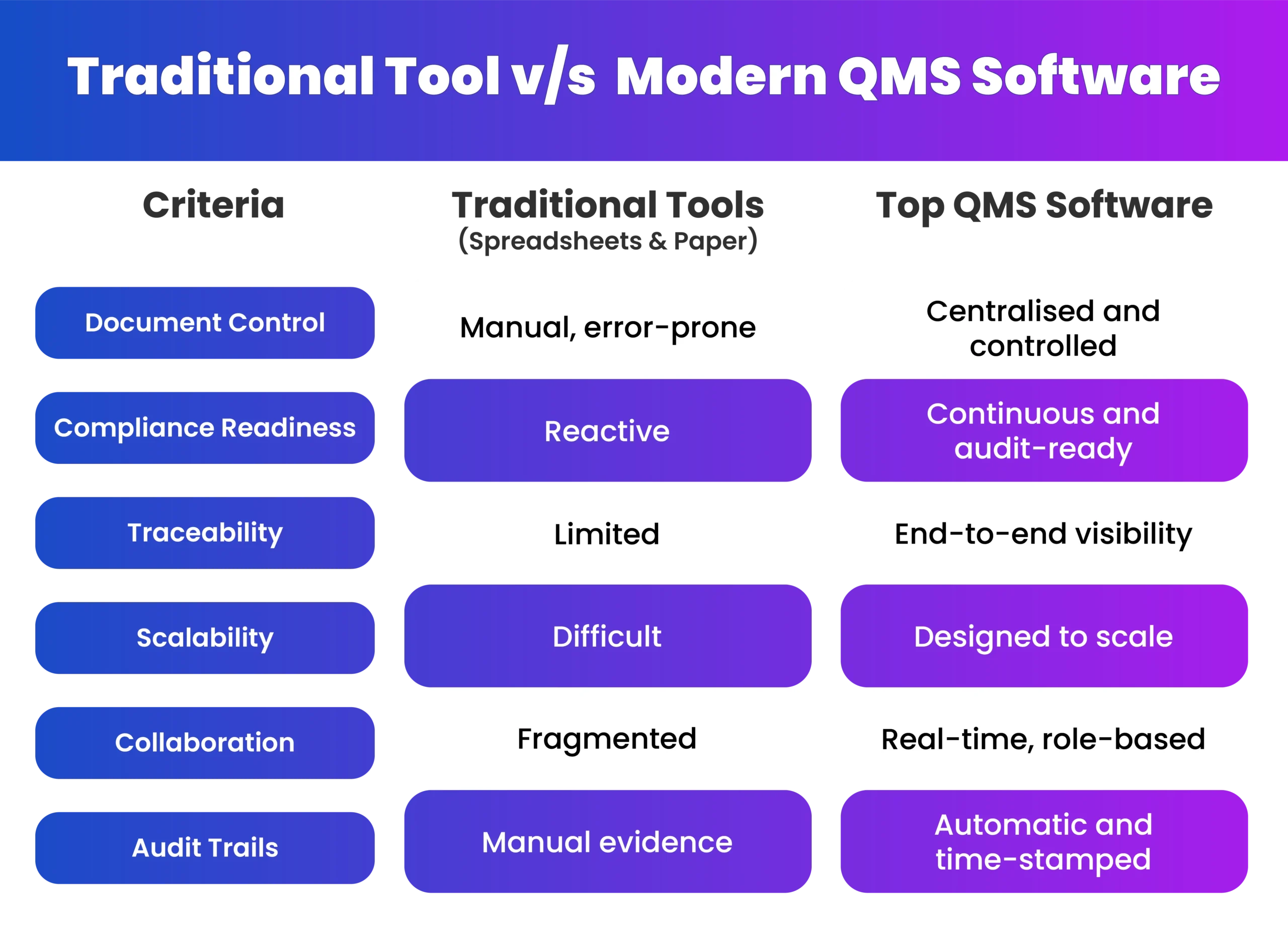
Why Modern QMS Software is Better Than Traditional Tools?
This comparison highlights why organisations increasingly replace manual systems with best quality management software solutions.
Introducing QualityPro: A Practical Approach to Digital Quality Management
While the principles of quality management remain consistent across industries, the way organisations implement and maintain those principles varies widely. This is where the choice of Quality Management Software becomes critical.
QualityPro by TecWork Global Business Solutions is designed to support organisations aiming to strengthen their Quality Management System without adding complexity. Instead of forcing teams to adapt to rigid tools, QualityPro provides a structured yet flexible platform that aligns with established QMS frameworks and real-world operational needs.
Trusted by Industry Leaders











What Makes QualityPro One of the Best QMS Software Solutions?
Built as a modern, web-based quality management software, QualityPro helps organisations manage quality processes in a controlled, transparent, and scalable manner through interconnected and centralised modules.
The modular structure of the software makes every module independent yet interconnected and offers seamless flow of data across the software. It enables teams to maintain consistency across documentation, approvals, and quality activities while ensuring traceability and accountability throughout the system.

Its intuitive design cuts the learning curve to bring ROI faster, and the cockpit view brings together critical quality metrics, tasks, and navigation so users can manage quality processes efficiently.
QualityPro focuses on helping organisations:
- Maintain control over quality processes as operations scale
- Ensure regulatory and internal compliance through structured quality data
- Improve visibility into quality performance and trends
- Support continuous improvement using reliable, system-driven insights
Rather than treating quality as a standalone function, QualityPro supports a more integrated approach - where quality becomes part of everyday operations across teams and locations.
By combining established quality management principles with digital efficiency, QualityPro enables organisations to move beyond manual quality management and build a more resilient, future-ready Quality Management System.
An ideal eQMS solution for businesses with small teams to an enterprise level, QualityPro by TecWork is actively used by ISO 9001 & ISO 14001 certified manufacturers. With SOC 2 Type II security, this best QMS software solution meets NABL, NABH compliance, and facilitates automotive organisations with IATF 16949 compliance.
Compliance QualityPro adheres to:
| ISO Standards | ISO 9001:2015, ISO 13485, ISO 27001:2022, ISO 14001:2015 |
|---|---|
|
Automotive |
IATF 16949 |
|
FDA |
FDA 21 CFR Part 11 |
|
Security |
SOC 2 Type II |
|
Life Sciences |
GMP |
|
Laboratory |
NABL Compliance |
|
Healthcare |
NABH Compliance |
How QualityPro QMS Can Transform Your Business
By automating audits, document control, and CAPA tracking, companies reduce manual admin hours and rework.
Digital SOPs and automated training assignments cut onboarding time significantly.
Improved defect tracking + faster NCR closure reduces recurring product issues.
Proactive risk assessment and root-cause analysis prevent high-impact defects.
QualityPro: Quality Management Software for Large Enterprises and Small Businesses
Quality needs don’t stay static as organisations grow. What works for a 20-member team today often becomes a bottleneck at 200. QualityPro is designed to bridge that gap - offering enterprise-level quality control without forcing smaller teams into complex, overbuilt systems.

For Small Businesses: Structured Quality Without the Overhead
Small and mid-sized organisations often struggle with informal processes, manual tracking, and audit anxiety. QualityPro by TecWork acts as a QMS Software for Small Business that brings structure early - without heavy implementation or steep learning curves.
It helps growing teams standardise processes, manage documents, track deviations, and stay audit-ready from day one. As quality maturity improves, the system evolves with you -eliminating the need to replace tools as regulatory and customer expectations increase.
For Large Enterprise Teams: Centralised Control at Scale
Large organisations require consistency across locations, departments, and compliance frameworks. QualityPro functions as a robust Enterprise Quality Management Software, enabling central visibility while allowing operational flexibility at the site or department level.
With controlled workflows, role-based access, end-to-end traceability, and real-time reporting, it supports complex governance structures and enterprise-wide quality alignment - without slowing teams down.

One QMS, Built to Grow With You
QualityPro by TecWork is an Enterprise Quality Management System by design - but engineered to remain practical for small and mid-size industries. Instead of separate systems for different growth stages, organisations use one platform that scales naturally with complexity, compliance demands, and operational footprint.
Whether you’re formalising quality for the first time or managing it across multiple business units, QualityPro adapts - so your quality system never becomes the limitation.
Frequently Asked Questions
A Quality Management System (QMS) is a structured framework of processes, policies, and controls used to ensure consistent product or service quality across an organisation. Rather than being a single document, a QMS system defines how quality objectives are set, how work is performed, how deviations are handled, and how improvements are made over time.
In practice, a QMS connects documentation, training, audits, corrective actions, and performance monitoring into a single quality management system. When supported by digital quality management software or an electronic quality management system, these activities become traceable, measurable, and easier to maintain as organisations scale.
A digital quality management system replaces manual tools such as spreadsheets, shared folders, and email-based tracking with structured, system-driven workflows. While a manual QMS relies heavily on human discipline, a digital QMS system software enforces consistency through version control, approvals, audit trails, and controlled access.
Digital quality management software improves reliability by ensuring that the right people use the right information at the right time. This shift significantly reduces errors, improves audit readiness, and enables organisations to analyse quality data rather than just store it.
eQMS software, also known as an electronic quality management system, is designed to digitise and manage all core quality processes within a single platform. Unlike standalone tools, eQMS systems integrate document control, audits, CAPA, training, supplier quality, and risk management.
By centralising these activities, quality management software QMS solutions provide full traceability across the quality lifecycle. This makes eQMS software especially valuable for organisations managing complex operations, multiple locations, or increasing regulatory expectations.
Web/Cloud-based QMS software is accessed through a browser and does not require local installation on individual machines. This makes web QMS solutions easier to deploy, update, and manage across teams and locations.
In contrast, traditional on-premises QMS software often requires device-specific setup, manual upgrades, and higher IT involvement. Web based quality management systems are therefore better suited for growing organisations that need flexibility, collaboration, and consistent access to quality data.
Enterprise quality management systems are built to handle higher volumes of data, more users, and more complex workflows. They typically support advanced permissions, cross-functional processes, detailed reporting, and integration with other business systems.
Enterprise quality management system software is essential for organisations operating across multiple sites or regions, where consistency and visibility are critical.
Unlike generic quality management software solutions, QualityPro is purpose-built around real-world quality workflows. The system focuses on usability, clarity, and process alignment rather than forcing organisations to adapt to rigid structures.
This balance allows QualityPro to function as both a structured electronic quality management system and a practical tool that teams can adopt quickly.
Yes. QualityPro is designed to meet the expectations organisations typically associate with top quality management software, including scalability, audit readiness, process coverage, and usability.
Its web-based QMS architecture ensures flexibility, while its structured workflows support consistency and control across operations.
Ready to Automate Quality Management?
Learn how QualityPro can elevate quality quotient of your product and boost ROI. Fill up the form and take one step towards stricter quality control, and maket dominance with QuailtyPro Quality Management Software.