


Imagine building a house.
You don’t just check the walls at the end and hope everything is strong and fine.
You start with a blueprint. You define construction standards and decide who does what.
You ensure every step meets the defined standards before moving forward. You train your staff.
That blueprint, the rules, the roles, and the structured way the work is planned and managed—that’s the Quality Management System (QMS). In simple words, it defines how the house will be built, what standards must be followed, and how consistency will be maintained from start to finish.
Now think about what happens during construction.
You verify the quality of materials before they’re used.
You check measurements before pouring concrete.
You inspect wiring before sealing the walls.
That ongoing, preventive checking, that’s Quality Assurance (QA).
It ensures the work is done right the first time, reducing rework, delays, and failures.
These are two aspects of Quality Management System (QMS) and Quality Assurance (QA). Although these two terms are often used interchangeably, they are not the same. They serve different purposes, answer different questions, and operate at different levels, yet both are essential. One cannot replace the other. One cannot be overlooked.
Keep reading this blog to clearly understand what QMS and QA really are, how they differ, why both matter deeply, how they connect, and how modern QMS software strengthens both without confusion or complexity.
What Is a Quality Management System (QMS)?
A Quality Management System (QMS) is the overall framework that defines how an organization manages quality across everything it does.
“It is not a single process. It is not a checklist. It is not limited to audits. “
A QMS is a system that brings structure and consistency to quality. It lays out how work should be done, who is responsible, and how results are measured and improved, so quality doesn’t depend on individual effort or memory.
A QMS includes:
- Quality policies and objectives
- Standard operating procedures
- Clear roles and responsibilities
- Risk management practices
- Document and change control
- Training and competency tracking
- Continuous improvement processes
Simply put, QMS makes quality repeatable. Even as teams change, operations scale, or regulations evolve, the system ensures stability and control – every single time!
What Is Quality Assurance (QA)?
Quality Assurance (QA) is the preventive side of quality. It ensures that processes are followed correctly and quality requirements are met before problems arise. Quality Assurance focuses on:
- Designing processes to reduce errors
- Defining quality standards upfront
- Verifying compliance with procedures
- Planning audits and reviews
- Ensuring effective training
- Preventing defects rather than fixing them
Difference Between Quality Management System (QMS) and Quality Assurance (QA)
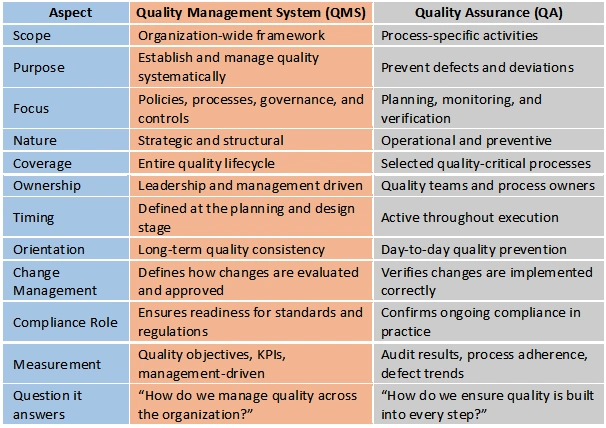
Also Read: Difference between Risk Management and Quality Management
How are QMS and Quality Assurance connected?
QMS and Quality Assurance are closely linked and operate as a single, unified system. QMS sets the direction by defining processes, rules, and expectations for quality, while Quality Assurance ensures those expectations are followed in everyday operations.
The structure created by QMS only becomes effective when QA actively checks, verifies, and reinforces it on the ground. At the same time, QA gains clarity and purpose from the framework QMS provides; established processes guide every audit, review, and preventive action.
Without QMS, QA lacks direction; without QA, QMS remains theoretical. Together, they turn quality from a documented intent into consistent, reliable execution.
How QMS Manages Quality Management
QMS is the foundation of quality management. It defines how quality is planned, governed, and sustained across the organization, before execution begins. QMS software creates this structure by setting standards, responsibilities, and controls that guide everyday operations.
By:
Defining Standard Ways of Working
QMS establishes SOPs, policies, and process definitions so work is performed in a consistent, approved, and repeatable manner. This removes dependency on individual judgment and ensures organization-wide uniformity.
Setting Quality Direction and Objectives
Through defined quality policies and measurable objectives, QMS aligns teams with clear quality goals. These objectives provide direction and act as benchmarks for performance and continuous improvement.
Managing Risks Before They Become Issues
QMS identifies risks within processes and defines preventive controls in advance, ensuring potential failures are addressed proactively rather than reactively.
Controlling Change Without Losing Compliance
QMS governs how changes to documents, processes, or systems are reviewed, approved, and implemented, maintaining compliance and stability even as improvements are introduced.
Ensuring People Support the System
QMS defines training needs and competency requirements so employees are qualified and capable of executing quality processes correctly.
Enabling Leadership Oversight
Management reviews within QMS allow leadership to evaluate system performance, identify gaps, and drive data-based improvements.
Through these aspects, QMS ensures quality is planned, structured, governed, and consistently managed across the organization.
Also Read: Difference Between Quality Control and Quality Assurance
How QMS Software Enables Quality Assurance
Quality Assurance focuses on verifying that defined quality requirements are being met during execution. Within a QMS-driven environment, QA primarily operates through inspections and calibration, ensuring outputs and measurements remain compliant.
By:
Monitoring Quality Through Inspections
Inspection activities verify that products, materials, or processes meet defined specifications before moving to the next stage. By capturing inspection data in real time, QA helps detect deviations early and prevent non-compliant outputs.
Ensuring Measurement Accuracy Through Calibration
Calibration ensures that measuring instruments and equipment produce accurate and reliable results. Proper calibration supports trustworthy inspections and quality decisions, reducing the risk of undetected errors.
With inspections and calibration, Quality Assurance confirms that quality already defined and structured by QMS is being correctly executed on the ground.
How QualityPro Supports Quality Management and Quality Assurance
QualityPro brings Quality Management and Quality Assurance onto a single platform, ensuring quality is clearly defined and consistently followed.
It helps build a strong quality foundation by centralizing SOPs, policies, and documents with version control and approvals, so teams always work with the latest approved processes. Risk and change management workflows maintain control as operations evolve, while training and competency tracking ensure employees are qualified.
On the Quality Assurance side, QualityPro digitizes audits, inspections, and calibrations, ensuring compliance activities are planned and completed on time. Non-conformances and CAPAs are tracked from identification to closure, with full traceability across documents and actions.
By replacing spreadsheets and emails with a connected system, QualityPro enables continuous compliance, stronger accountability, and reliable quality execution, every day, not just during audits.
A modern QMS is no longer just a compliance tool; it’s the backbone of strong Quality Management and effective Quality Assurance. By bringing SOPs, audits, inspections, NC/CAPA, training, and traceability into one system, QMS software ensures quality is planned, executed, monitored, and continuously improved.
The result is fewer deviations, better compliance, and consistent product and process performance across the organization. So, strengthen quality from planning to execution with QualityPro.
Schedule a demo and see it in action.