


What Is Quality Control in Plastic Industry & Why It Matters
Quality control in plastic industry refers to systematic processes and standards designed to ensure that plastic products consistently meet predefined quality specifications such as dimensional accuracy, mechanical strength, and regulatory requirements.
Effective quality control not only reduces defects but also enhances customer satisfaction, lowers cost, and improves operational efficiency – especially in high-volume, precision-driven environments like plastics production.
Many manufacturers are now also integrating digital approaches into quality control to improve accuracy and speed. For example, according to ZipDo – 49% of plastic manufacturing companies report improved product quality through Quality Management Software Solutions, indicating the strong influence of modern technologies on quality outcomes.
How Quality Control in Plastic Manufacturing Works
Quality control in plastic manufacturing is a continuous process that starts before production and continues through post-production inspection. It involves:
- Raw Material Inspection – Checking resin batches, additives, and other inputs for consistency before they enter production.
- In-Process Monitoring – Measuring critical parameters – such as temperature, pressure, and cycle time – during extrusion, moulding, or thermoforming to maintain stability.
- Product Inspection – Checking finished parts for defects such as warpage, blemishes, dimensional errors, or improper wall thickness.
- Data Analysis – Using statistical tools to track quality trends and address deviations early.
This layered approach ensures defects are minimised, costs are controlled, and final products meet customer expectations.
Why Digital Quality Control Trends Matter
Industry data shows that digital tools are becoming essential to quality control:
- According to ZipDo – 78% of plastic manufacturers have adopted digital tools to improve manufacturing processes.
- WifiTalents says – 40–49% of plastics companies use digital quality systems such as automated inspection tools and IoT sensors to enhance product consistency.
These digital integrations help modernise quality control – enabling faster identification of defects, tighter tolerances, and improved real-time decision-making.
What Is a Quality Management System (QMS) in Plastic Manufacturing
QMS in Plastic Production is a framework of structured processes designed to manage quality across every stage of plastics manufacturing. A robust QMS:
- Standardises procedures from supplier evaluation to final inspection
- Tracks quality metrics over time
- Provides documentation for audits
- Supports continuous improvement activities
Most strong QMS frameworks align with recognised standards such as ISO 9001, which help organisations benchmark their quality procedures against global best practices. These systems help ensure consistent outcomes and operational transparency.
What are Benefits of QMS in Plastic Production
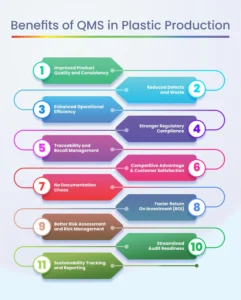
Below are detailed benefits of implementing QMS in Plastic Production:
1. Improved Product Quality and Consistency
Implementing a QMS aligns quality control in plastic manufacturing with standardised procedures that reduce variability and defects.
- In one documented case, a plant certified under ISO 9001 saw product rejection rates drop by around 30%, significantly improving consistency.
2. Reduced Defects and Waste
Efficient quality management systems help identify deviations before they become systemic issues:
- Digital quality control systems have enabled many plastics manufacturers to reduce scrap and rework time through real-time monitoring and early fault detection, highlights ZipDo.
- Centralised quality data also helps guide Corrective and Preventive Actions (CAPA) to prevent repeated issues.
3. Enhanced Operational Efficiency
A structured QMS enables smoother operations and better workflow coordination:
- According to ZipDo, 65–78% of plastics manufacturers report increased efficiency as a result of digital transformation initiatives, which often include quality data platforms and process analytics.
- Improvements include faster production cycles, fewer bottlenecks, and reduced downtime caused by quality-related hold-ups.
4. Stronger Regulatory Compliance
Plastics manufacturing is subject to evolving environmental and safety regulations. Comprehensive quality control supported by a QMS simplifies compliance documentation, enabling easier audits and faster approvals.
5. Better Traceability and Recall Management
Traceability is a crucial capability of a QMS. When defects occur, a robust quality control in plastic industry setup can instantly trace raw materials, production batches, and inspection results. This enables
- Faster containment of defects
- Efficient recall execution
- Lower risk of brand damage
Digital quality data tracking systems integrate batch history with production outcomes, providing a comprehensive audit trail.
6. Competitive Advantage and Customer Satisfaction
Higher quality standards lead to stronger market positioning:
- Manufacturers with well-integrated QMS frameworks often see higher customer satisfaction and repeat business due to consistent quality and on-time deliveries.
- Digital quality control and automation also help meet customer expectations for reliability and compliance.
7. No Documentation Chaos
One of the biggest challenges in quality control in plastic industry is managing large volumes of documentation across departments. A structured QMS in plastic production eliminates documentation chaos by digitising, classifying, and centralising all quality-related records.
A QMS enables manufacturers to:
- Store regulatory documents, SOPs, and work instructions digitally
- Maintain moulding and extrusion process parameter logs
- Manage employee training records and competency matrices
- Archive dispatch, packaging, and compliance records
- Control versions and automatically remove obsolete documents
With clear document ownership, version control, and easy retrieval, quality teams avoid confusion, reduce errors, and ensure that only the latest approved documents are used on the shop floor. This directly strengthens quality control in plastic manufacturing and audit compliance.
8. Faster Return On Investment (ROI)
A well-implemented QMS contributes directly to faster ROI by reducing quality-related losses and improving production efficiency. Integrated inspection and calibration processes ensure that machines, tools, and instruments operate within defined tolerances.
This results in:
- Fewer process deviations
- Reduced rework and scrap
- Improved first-time-right production
- Shorter product-to-market cycles
By identifying quality issues early and ensuring equipment accuracy, manufacturers minimise costly defects and delays. Over time, these operational gains translate into quicker financial returns, making Quality Management in Plastic Production not just a compliance tool but a business enabler.
9. Better Risk Assessment and Risk Management
Risk is inherent in plastic manufacturing due to multiple variables such as raw material quality, process parameters, machine calibration, and human involvement. A structured QMS helps organisations proactively manage these risks rather than reacting after failures occur.
With a formal risk management approach, manufacturers can:
- Identify potential risks across materials, processes, and equipment
- Assess and categorise risks based on severity and likelihood
- Document mitigation strategies and preventive controls
- Track actions taken and review effectiveness
This systematic risk assessment framework significantly reduces the chances of defects, recalls, and compliance failures, strengthening quality control in plastic manufacturing at every stage of production.
10. Streamlined Audit Readiness
Regular audits are a critical part of operating in regulated manufacturing environments. A robust QMS in plastic production ensures that organisations remain audit-ready at all times rather than scrambling during audit cycles.
A QMS supports audit readiness by:
- Maintaining complete and time-stamped audit trails
- Recording non-conformities and corrective actions
- Tracking preventive actions and closure status
- Storing inspection, calibration, and compliance records centrally
With all data organised and easily accessible, audits become smoother, faster, and less stressful. This improves compliance confidence and reduces the risk of audit observations or penalties.
11. Sustainability Tracking and Reporting
Sustainability has become a key focus area for the plastics sector, with increasing pressure from regulators, customers, and stakeholders to reduce environmental impact. A modern QMS enables manufacturers to track and report sustainability-related metrics accurately.
Through structured data capture, organisations can monitor:
- Scrap and waste generation
- Resource and energy consumption
- Recycling and reuse rates
- Emission and environmental compliance data
These insights help manufacturers set measurable sustainability goals, track progress over time, and generate transparent reports for regulators and clients. By integrating sustainability into quality control in plastic industry, a QMS supports responsible manufacturing and long-term business resilience.
How to Implement a QMS in Plastic Manufacturing
A successful QMS in plastic production should be tailored to the specific needs of the facility but typically includes:
1. Clear Documentation and Standardised Processes
Develop documented procedures for key operations – from raw material inspection to final product testing.
2. Digital Data Capture and Integration
Use digital systems to capture real-time production and inspection data to drive analytics and improve decision-making.
3. Corrective and Preventive Action Systems
Implement formal CAPA procedures so quality faults are systematically investigated and prevented in the future.
4. Employee Training and Competency Checks
Employees should be trained regularly on SOPs, quality tools, and inspection techniques – a key aspect of effective quality control.
Key Take aways:
- Quality control in plastic industry is most effective when it is process-driven rather than inspection-led.
- A structured QMS in Plastic Production ensures consistent control over raw materials, machine parameters, and finished product quality.
- Quality control in plastic manufacturing becomes scalable and repeatable when documentation, audits, and corrective actions are centrally managed.
- A QMS helps plastic manufacturers reduce defects, minimise scrap, and improve traceability across production batches.
- Regulatory compliance and audit readiness are significantly improved through controlled documentation and real-time quality records.
- By embedding quality into daily operations, a QMS supports long-term efficiency, sustainability, and customer confidence.
Conclusion
Implementing QMS in Plastic Production is essential for organisations looking to strengthen quality control in plastic industry and achieve higher operational excellence. By standardising processes, leveraging digital quality insights, and strengthening compliance readiness, companies can unlock real business value:
- Fewer defects and waste
- Higher customer satisfaction
- Better market reputation
- Faster production cycles
- Data-driven continuous improvement
In today’s competitive landscape, a robust QMS Software for Manufacturing Industry is not just a quality backbone – it’s a strategic advantage that helps plastic manufacturers thrive in an increasingly digital and data-centric environment.
Frequently Asked Questions
A QMS standardises procedures, centralises data, enforces traceability, and supports continuous improvement — reducing variation, waste, and compliance risk.
Calibration ensures that machines, sensors, and measuring instruments provide accurate reading. In plastic manufacturing, even minor calibration errors can lead to dimensional deviations, poor surface finish, or material degradation. A structured QMS links calibration schedules with inspection results to prevent quality drift.
Plastic manufacturing is highly sensitive to variations in temperature, pressure, and cycle time. A QMS in plastic production helps define approved process ranges, record deviations, and trigger corrective actions when parameters move outside limits, preventing defects and rework.
Yes. By reducing defects, rework, and approval delays, a QMS improves first-pass yield and accelerates product releases. Strong quality control in plastic industry directly contributes to faster and more predictable delivery timelines.