


A nonconformance in quality management means something failed to meet a required standard. It could be a defective part, a flawed process, sub-standard documentation, or a service not delivered correctly. Without a proper approach, these issues can slip through and hurt your business.
Let us understand these with some examples.
Example 1: You are in the business of manufacturing glass studs of size 50 mm. But an inspection revealed that a particular lot of the studs measure 45 mm.
Example 2: A product you recently delivered to a customer didn’t match their specification and was of a different color. Moreover, it was delivered to the wrong address initially. You came to know this when a customer complaint was received in this regard.
Example 3: Crucial details such as temperature information, and the supervisor’s signature, are missing from your batch records.
In these examples, nonconformances were triggered because the output or the step didn’t meet the set standards. If these are not treated on time, or treated without a proper approach, these issues can jeopardise your business.
That’s where a Nonconformance Management System becomes important. It helps identify, record, investigate, and resolve nonconformances systematically. In doing so, it reduces risk, lowers cost, and shores up quality and compliance. Below, you’ll find the key benefits of the system.
What is Nonconformance in Terms of ISO
ISO has the following set of criteria:
- A business organisation must consistently offer quality products and must operate appropriately under the regulatory measures of ISO.
- When an organisation goes outside the regulatory boundaries, it must control and fix the problem before continuing business.
- A business must satisfy its customers.
- A business must maintain the safety and security of its employees as well as customers.
If a business does not satisfy the above highlighted criteria, it is said to have nonconformance which could dent its market reputation.
What is a Nonconformance Management System
Nonconformance management is fundamentally the process whereby the organisations manage nonconformances in a way that they are promptly identified, properly documented, thoroughly investigated, appropriately segregated and dispositioned based on applicable regulations and standards.
A Nonconformance Management System is a structured framework (manual or software-based) that helps organisations to:
- Record nonconformances when they occur – whether in production, inspection, documentation or service.
- Capture details: what failed, why, when, who discovered it, and where.
- Contain the issue – stop further use or dispatch of faulty items.
- Investigate root cause.
- Take corrective or preventive actions (CAPA) to eliminate root cause.
- Maintain audit-ready records and evidence trails (photos, sign-offs, test results, closure date).
- Track metrics for future prevention and continuous improvement.
A Nonconformance Management System can be as simple as shared spreadsheets and forms – but in many firms, it’s part of a Quality Management System (QMS) solution, linked to audit, CAPA and compliance modules.
For effective and efficient nonconformance management, organisations rely on nonconformance management software. The investment made in a Nonconformance Management System is a massive decision and can potentially make or break an organisation. That’s why businesses need to invest in the right software, which can offer a number of benefits.
Why Nonconformance Matters – Cost & Risk
In manufacturing and operations, poor quality often carries a heavy price. Many companies incur heavy quality-related costs – including waste, scrap, rework, returns, complaints, and lost customers – amounting to 15–20% of total revenue.
In many organisation’s cost of poor quality may rise up to 30% of operational cost.
In industries where regulation and safety are critical (e.g. medical devices, aerospace), the cost of failure may include customer recalls, regulatory fines, reputational damage – costs far beyond scrap or rework. (McKinsey)
This demonstrates that nonconformance is not just a quality alert, it is a potential profit killer. Hence, a robust Nonconformance Management System is a must for any organisation.
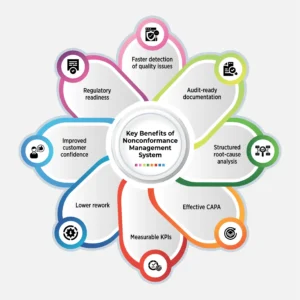
Key Benefits of Nonconformance Management System
Here are the main advantages of having a well-implemented Nonconformance Management System:
Faster detection and containment of quality issues
- Nonconformances get logged the moment they’re identified.
- The system highlights path of flow – so suspect products or batches can be stopped, quarantined or held before reaching customers.
- This reduces defective items reaching customers – fewer complaints, returns, and recalls.
Clear traceability and audit-ready documentation
- Every nonconformance has a record – what failed, where, when, by whom, why.
- Attach evidence – test reports, photos, sign-offs, corrective actions, closure log.
- For audits – internal or external (e.g. under ISO 9001) – this traceability demonstrates compliance and good quality practice. This supports regulatory readiness and quality certification.
Structured root-cause analysis and effective CAPA
- Nonconformance Management System ties nonconformance to CAPA workflows -ensuring problems are not just fixed once, but root causes addressed to prevent recurrence.
- Helps transition from reactive fixes to proactive prevention and continuous improvement.
- Over time, this reduces repeat defects and improves stability of processes.
Measurable KPIs
With Nonconformance Management System you can consistently track:
- Number of nonconformance reports per month / quarter.
- Average time to close nonconformances.
- Recurrence rate.
- Cost per nonconformance report.
- CAPA effectiveness rates.
This data enables fact-based decision making. You can prioritise where to improve, which processes need attention, and so forth.
Lower reworks, scrap waste
- Early detection + corrective action reduces rework and scrap.
- Prevention reduces waste of materials, labour, time.
Improved customer confidence and brand reputation
- Demonstrating robust quality practices builds customer trust.
- Transparent processes documented corrective action help when issues do occur.
- Fewer recalls, fewer complaints, fewer warranty claims yield stronger customer loyalty.
Regulatory and audit readiness
- The documentation trail simplifies internal audits, external audits, certification efforts (ISO, regulatory bodies).
- Reduces audit stress and the risk of non-compliance penalties.
- Provides supportive records if regulatory issues arise.
When Nonconformance Management Matters the Most
Nonconformance Management System brings the most value when:
- You deal in manufacturing or assembly – parts, components, electronics, discrete manufacturing.
- You run regulated industries – medical devices, automotive, aerospace, food & pharma, where compliance and traceability are mandatory.
- You have batch production, high volume, or repeat processes.
- You face frequent audits – internal, customer, or regulatory.
- You need customer satisfaction, reduction in returns, recalls, defects, and warranty claims.
If your business prioritises any or many cases stated above, investing in Nonconformance Management System is considered an imperative decision which could help reduce scrap and foster better brand reputation.
Why Many Firms Still Skip Nonconformance Management System
Despite the clear benefits, many firms remain reactive – they deal with defects ad hoc, rely on firefighting, and lack proper recording or root cause follow-up. Common reasons:
- No culture or discipline to log defects consistently.
- Fear or reluctance among shop-floor staff or production teams.
- Lack of tools or resources – spreadsheet or manual tracking seems “too much work”.
- Cost pressure – quality is considered overhead, not investment.
- No visibility into long-term cost of poor quality – costs remain hidden (waste, rework, delayed deliveries, customer impact).
But skipping Nonconformance Management System doesn’t make risks go away. It pushes cost and liability under the carpet – until a serious issue (customer complaint, recall, audit failure) forces it to surface.
Summary
A Nonconformance Management System isn’t just a tool for quality assurance. It’s a strategic business instrument. It helps you:
- Cut costs and waste.
- Improve customer satisfaction.
- Enable traceability and compliance.
- Turn reactive fixes into proactive, preventive quality culture.
- Make data-driven decisions.
- Protect reputation and reduce liability.
If your organisation produces products, components, or delivers services that must meet standards, invest in a functioning Nonconformance Management System.
It could be a standalone solution, or a part of a manufacturing QMS software. Regardless of how it comes into the system, it should address risks and allow the internal/external stakeholders to browse reminders, conformance notifications, and the escalated issues related to quality.
It makes sense for businesses to invest in a fit-for-purpose Nonconformance Management System that delivers these benefits. If your existing system is not good enough, it would be prudent to explore other options. One such option is QualityPro by TecWork Global Business Solutions, a best-in-class QMS with a potent nonconformance management functionality.
Write to us on sales@tecwrk.com for more information, or schedule a demo to explore the software live.